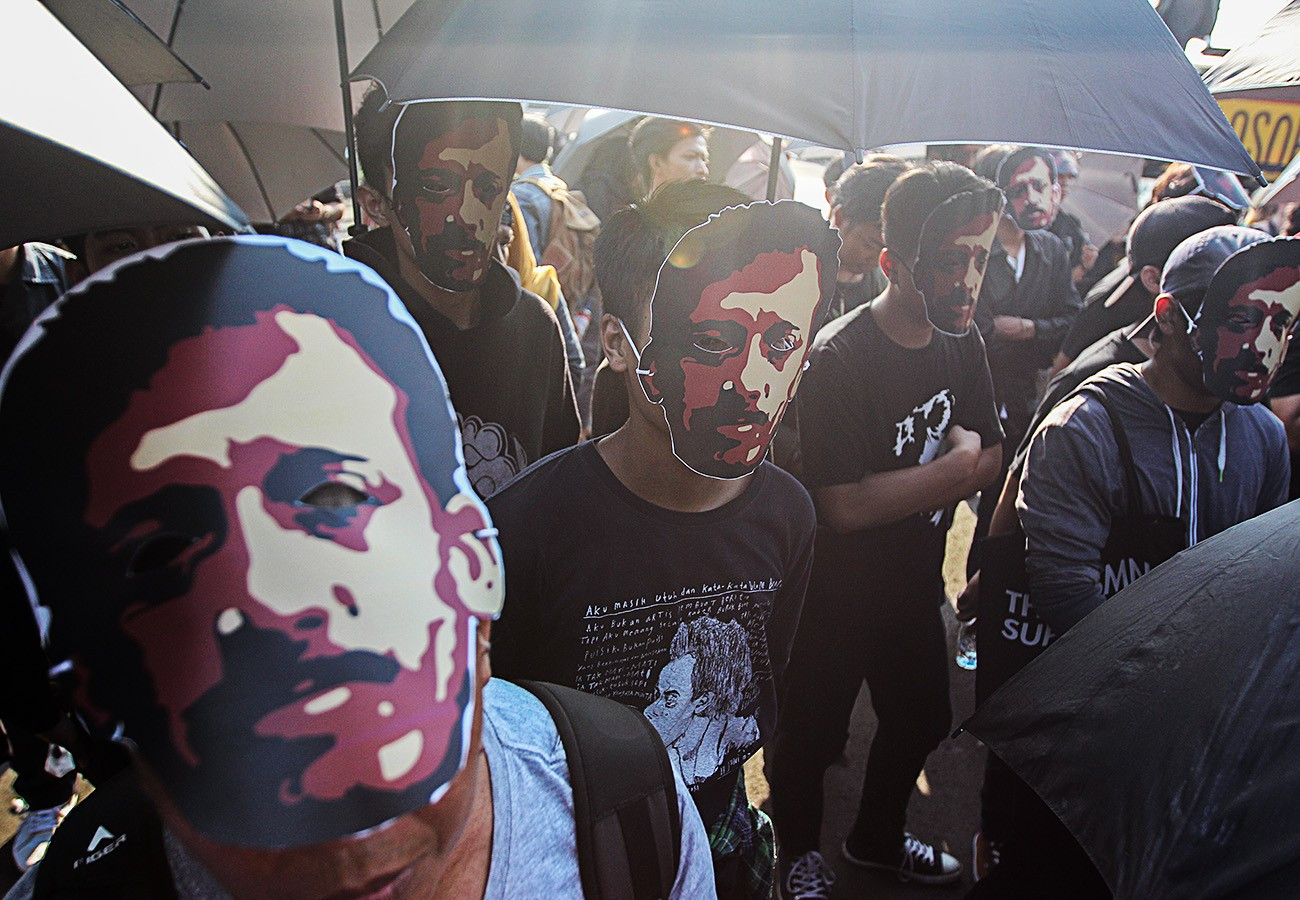
HARI PERJUANGAN HAK ASASI MANUSIA - 25 Maret 2026
ESAI
June 20, 2025
Mugiyanto
Living in the Struggle
In his life, Munir has fully dedicated himself to defend the victims of politics and injustice by the state. That is why he has taken the right step by choosing a Legal Aid Institute (LBH) as a place to defend the victims’ human rights.
By Mugiyanto
In his life, Munir has fully dedicated himself to defend the victims of politics and injustice by the state. That is why he has taken the right step by choosing a Legal Aid Institute (LBH) as a place to defend the victims’ human rights. At Surabaya Legal Aid Institute (LBH Surabaya), he became the Head of the Labour and Civil Rights – a position in which he had to directly deal with the state’s repressive instruments such as military, as well as the policies against the labour and democracy.
In 1993, Munir together with activists from NGOs did investigations and campaigns over the death of Marsinah, a female worker who was murdered after leading a strike in Sidoardjo. She encouraged her co-workers to stop working. At that time, the case became a national issue. It was even taken before the UN Commission for Human Rights.
The main perpetrator was strongly assumed to have involved the military. Munir, then, was elected as the secretary of The Solidarity Committee for Marsinah (KASUM). This case has brought his name to the national stage as a courageous person who obviously accused the military of being responsible for the murder of Marsinah. An attitude which was rarely possessed by the human rights defenders at that time. The military felt annoyed by Munir’s courage and strong willingness to keep moving forward to make them be responsible for Marsinah’s death.
Then, Munir was ‘abducted’ and intimidated by the Bakorstanasda[1] of Brawijaya Military Command (KODAM) in Surabaya. They asked him to stop all his campaigns and quit making statements that might have endangered the position of the military. The result however was that he became more confident that the military had had a connection to Marsinah’s death. He then continued fighting for Marsinah’s case until it was taken before the the UN Commission for Human Rights.
Advocacy for Marsinah’s case has shown how exactly Munir was like. He was not scared at all to defend the human rights, although he had to deal with the most powerful enemy, the military. His attitude has become the most important thread of his career as a human rights defender who stood against the military. Also, he also got involved in defending and advocating the victims of gross human rights violations in Aceh and East Timor, two military operation regions for more than ten years.
The highlight of Munir’s struggle for human rights and contribution to the next enforcement process of human rights was when he established a Commission for Disappearances and Victims of Violence (KONTRAS) in March 1998 in which he become the head. Its establishment began with investigations on a series of systematic abductions of some pro-democracy activists by the Army Special Forces (Kopasus) that happened since mid 1997 to mid 1998 in relation to the People’s Consultative Assembly General Session (SU MPR) when the Jenderal Besar Soeharto was elected as the President of Indonesia for the seventh time. At that time, the Commander of Kopasus was General Major Prabowo, Soeharot’s son-in-law.
Some victims of abductions who were released through the efforts of Munir and KONTRAS have done campaigns, lobbying, actions and pressures on the government and military in order to make them admit their involvement and also release all victims of abductions who were still detained.
In its history, we can say that Indonesia has never had a general suspended because of having led an operation or a policy which violated human rights. In most cases, it only happened at the troop level. However, Munir and KONTRAS with all the supports from the victims and their families has successfully urged Military Honor Council (Dewan Kehormatan Militer) to suspend Lieutenant General Prabowo Subianto who at that time became the Commander of the Army Strategic Reserve Command (Pangkostrad).
Nevertheless, all investigations and courts on the perpetrators of the abductions still showed that there was ‘impunity’ process for those who held the military command. Knowing that investigations on the cases of involuntary disappearance by the state were not completely done, Munir encouraged the victims and their relatives to establish an Indonesian Association of Families of the Disappeared known as IKOHI in late 1998. Then, IKOHI continued taking important measures needed in order to persecute the state responsibility and to look for those still disappeared. IKOHI does not only act as a campaign machine, but it also functions as an organization for ‘the movements of the victims’, which can empower the politics among the victims, their families and societies. The impunity for the perpetrators of the human rights violations has also bothered Munir’s mind, especially when the Draft Law of the Truth and Reconciliation Commission started being deliberated by the Parliament (Dewan perwakilan Rakyat) since last year. He noticed that it was not the right time to propose the draft considering the ‘political situation’ which could have resulted in law products that legalized impunity ended with a reconciliation “without truth and justice”.